

Digital dentistry
What isdigital dentistry
Digital dentistry is a modern branch of dentistry that uses advanced technologies to improve the diagnosis, design, and implementation of dental treatments. With innovative tools such as intraoral scanners, CAD/CAM software, and 3D printers, more accurate, faster, and more comfortable results can be achieved for patients.
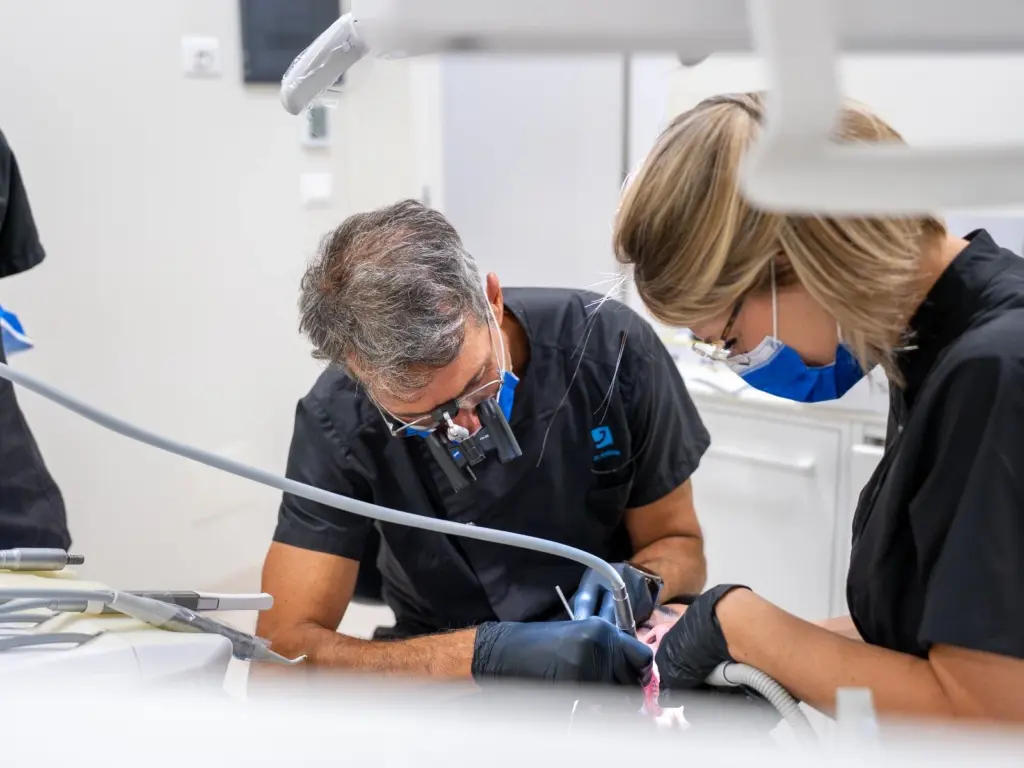
Why prefer intraoral scanners over traditional procedures?
Intraoral scanners and 3D printers to create precision work in the mouth, hardly the most comfortable environment in which to work, there has always been a need to reproduce the situation of the mouth in models, on which operations can then be performed with precision and accuracy. Precision is what then allows a work to function over the years. To obtain the models, liquid plaster was poured inside impressions of the mouth, which like negatives were printed on the teeth.
These materials often had unpleasant odors and tastes, which combined with the sensation of having a full mouth and during extraction of the hardened cast, the sensation of strong pressure on the teeth, gave an unpleasant experience for the patient. The advent of digital imaging has revolutionized the way of working in many areas of industry and health care, and even dentistry. Soft-material impressions have been replaced by intraoral scanners, which have achieved accuracy values comparable to, and sometimes superior to, traditional analog techniques.
How do intraoral scanners work ?
The intraoral scanner is a camera that inserted into the mouth, scans the dental arches and reproduces a digital model. The advantages are innumerable. The scan does not give discomfort or sense of vomiting to the patient The files can be stored on the PC without the need to have them physically in the office. One can work and design directly on the computer by creating them digitally, just as an engineer does with his parts. There is no need to repeat the impression each time, because the model, being a file does not spoil but can be copied and pasted as many times as desired. The scanner scans colors, so it is easier to communicate with the patient and explain their oral situation The color of the teeth can be determined with the scanner so that teeth can be reproduced in the dental laboratory more aesthetically faithful.
You can work with the best labs around the world because the files can also be sent by email. In addition, digital models, should you want to touch them with your hands, can be printed with a 3D printer
Maximum precision with the 3D printer
The printer injects resin particles that go into the pattern just as a printer does on paper with ink. The processes are much cleaner and more hygienic as there is no dust or plaster The models are much more durable as the resin is more resistant to accidental fracture. The accuracy of a machine like the one at the dr gallon dental center is exhilarating, and it has no material-related distortions or bubbles. Digital dentistry, in addition to having revolutionized the possibilities in diagnosis and communication, have also created new opportunities, created by the new aesthetic, metal-free materials that can be cemented to teeth at minimal biological cost and with reduced time and number of sessions.
What is optical digital dental impression?
Optical digital dental impression is a modern technique used in dentistry to detect the shape of teeth and gums using an intraoral scanner, without the use of traditional impression pastes.